February 2026 skies
BY: DICK COOKMAN & Elias Russell
Highlights: Focus Constellations, Comets, Mars, Meteor Showers, Planet Plottings, February Moon
🌌 Focus Constellations: February’s focus constellations are the winter constellations: Orion, Auriga, Gemini, and Cancer
☄️Comets – Space Visitors on the Move
This month’s main comet is C/2024 E1 (Wierzchoś) peaking around magnitude 8-9 on February 17th. Although best seen from the Southern Hemisphere, it will be in the constellation Cetus around the end of the month and will offer good viewing for binoculars in the Northern Hemisphere.
🚀 Mars – What are the Rovers Up To?
Some exciting news for Mars rovers: After testing artificial intelligence in Perseverance in late 2025, it is now running a vision language model to reduce the workload on human controllers from Earth, allowing Perseverance to navigate routes autonomously. Perseverance is still exploring Jezero Crater and headed to Lac De Charmes to study older rocks. It is also performing tests to evaluate conditions which future spacesuits must surmount during interaction with the Martian environment.
Curiosity continues to explore Gale Crater, studying rocks and sediments which reveal the geological history of Mars. The search for substances with molecules definitively formed by organic processes continues…
🌟 Meteor Showers
This month proves to be a quiet month for meteor showers in the Northern Hemisphere. Earth is orbiting through a region of space with little debris left by the passage of previous comets.
The Southern Hemisphere skies host the Alpha Centaurids, which could potentially produce meteors that encroach into the southern Northern Hemisphere skies.
🪐Planet Plottings
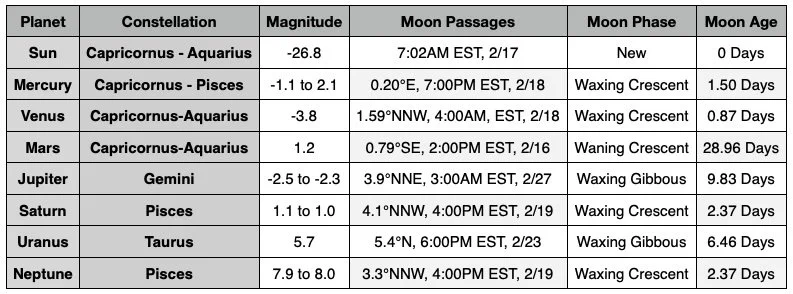
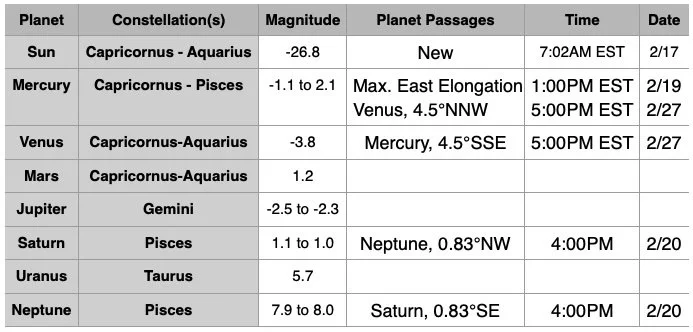
Mercury and Venus are emerging into the evening sky in February. After its early January superior conjunction with the Sun, Venus (-3.8) is low in the WSW early evening sky in Capricornus and Aquarius this month and sets after the Sun. It can easily be seen in Aquarius in the sunset sky on the 10th below Mercury (-1.1 to 2.1) which moves through Capricornus, Aquarius, and Pisces in February. The waxing crescent Moon passes Venus and Mercury on the 18th, the day before the latter reaches greatest eastern elongation (18°) from the Sun on the 19th. Mercury then sinks into the afterglow of the setting Sun and appears to pass within 5° of Venus on the 27th as it moves toward inferior conjunction with the Sun in early March.
Neptune (7.9 to 8.0) and Saturn (1.1 to 1.0) in Pisces, Uranus (5.6 to 5.7) in Taurus, and Jupiter (-2.5) in Gemini, are also evening planets. Neptune and Saturn are early evening planets setting about 2 hours after the Sun. They will be in close proximity all month and will be less than a degree apart on the 20th. The waxing crescent Moon will pass each on the 19th. Uranus sets in mid-evening on the 1st and before midnight on the 28th. The waxing gibbous Moon passes it on the 23rd. Jupiter is by far the brightest of the four, it peaked in brilliance for 2026 when reaching opposition with the Sun on January 10. It will be passed by the waning gibbous Moon on the 27th.
Mars (1.2) in Capricornus and Aquarius rises slightly before the Sun but appears very close to it and is still buried in its glare after passing through solar conjunction in January. The waxing crescent Moon passes Mars on the 16th.
Notable Events - Planetary parade!
On February 28th, Mercury, Venus, Saturn, Jupiter, Uranus, and Neptune will be visible along the ecliptic after sunset creating a rare “planetary parade.”
🌚 February Moon
The New Moon on February 17 at 7:02AM EST in Sagittarius provides Antarctica and the southern oceans with an annular (Ring of Fire) solar eclipse! The New Moon marks the start of Lunation 1276 which ends 29.6 days later with the March New Moon in Pisces on the 18th at 9:25PM EDT.
The Full Moon occurs on February 1 at 5:09PM EST, the evening before Groundhog Day or Candlemas. February 2nd is a cross quarter day (half way between the December solstice and March Equinox). Ancient Celts celebrated it as a seasonal change. The Romans imposed their calendar upon the conquered Celts, whereupon the Roman Catholic church redefined the celebration as Candlemas - the Feast of the Presentation of Jesus Christ. According to threeriversparks.org: “Groundhog Day originally had nothing to do with groundhogs (or Bill Murray during the last millennium). It started long ago in Europe as the pagan festival of Imbolc which marked the start of spring. It was renamed Candlemas by early Christians who believed a sunny day meant more cold weather and snow was coming. Next, Germans added animals – mainly badgers – to the legend by declaring it sunny if the animals saw their shadows. Finally, this legend was brought to the U.S. by German immigrants to Pennsylvania who adopted the groundhog as their animal of choice to see its shadow. The first official Groundhog Day was held on February 2, 1887 by a group of Punxsutawney businessmen.”
The February Moon is known as the Wolf, Snow, or Hunger Moon. In Medieval England, it was called the Storm Moon. For Celts, it was the Moon of Ice, and in China, it is the Budding Moon. Colonial Americans called it the Trapper’s Moon. Eastern and western dialect Anishinaabe (Odawa, Ojibwe, Potawatomi and others) first people respectively recognize the 2nd Moon of the year as Mkwa-giizis (Bear Moon) and Namebini-giizis (Suckerfish Moon). According to Grandmothersvoice.com, “Cultural teachings explain the cycle of life and nature of February’s Grandmother Moon of Creation: Bear Moon, the second moon, marks the beginning of a vision quest initiated in the fall. During this time, we learn to see beyond the ordinary and communicate through energy rather than words.”
Lunar apogee (maximum lunar monthly distance) is on February 10 at Noon EST when the Moon’s distance is 251,388mi. (64.43 Earth radii). Lunar perigee is on the 24th when the Moon is at 229,997 mi. (58.03 Earth radii) at 6:25PM EST.