march 2026 skies
BY: DICK COOKMAN & Elias Russell
Highlights: Focus Constellations, Comets, Mars, Meteor Showers, Planet Plottings, March Moon
🌌 Focus Constellations: Focus constellations in March mark a transition from winter to spring. Early in the month, winter constelllations like Orion, Taurus, Canis Major, and Gemini in the southwestern skies, give way to spring ones like Leo, Cancer, Bootes, and Ursa Major in the southeastern evening skies.
☄️Comets – Space Visitors on the Move
C/2024 E1 (Wierzchos), a hyperbolic Oort Cloud object in Taurus, is the most favorable comet this month peaking at a brightness of 8.5, requiring binoculars or a small telescope. Comet C/2025 R3 (PanSTARRS) is a 12th magnitude long-period, comet in Pegasus that is expected to make a close approach to the Sun on April 19–20, 2026, and Earth on April 26–27, 2026. It may become visible to the naked eye (magnitude 3?).
🚀 Mars – What are the Rovers Up To?
Perseverance is exploring Jezero Crater still and is utilizing new Mars Global Localization technology, which functions like a GPS allowing Perseverance to determine its precise location on its own. Using new AI it is able to cover substantially more ground without the need for human control. Its current mission is to sample and find rocks in the Lac de Charmes region, while its recent findings of potential evidence of life in the Cheyava Falls has increased the search for biosignatures on Mars.
Curiosity is finishing up its mission studying the boxwork formations (structures likely formed by ground water) on Mount Sharp. Once complete, the rover will continue traveling for miles studying sulfate-rich layers that may explain how Mars dried up billions of years ago. Recently, Curiosity has also done some chemistry on its onboard lab to try and detect organic compounds in the boxwork region.
🌟 Meteor Showers
March is a quiet month for meteor showers, with no major events happening in the Northern Hemisphere. The months of October through early January host a majority of the more active meteor showers, with late April through August running a close second. The relative absence of meteor activity from mid-January through mid-April presents an interesting puzzle.
Notable Events
March 3rd, 2026 features a blood moon total lunar eclipse! Spring Equinox - March 20, 10:45AM EDT.
🪐Planet Plottings
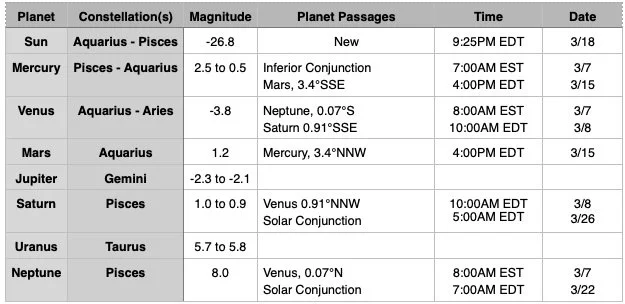
Early March evening planets are aligned just above the western horizon in order. Mercury, brilliant Venus, Neptune, and bright Saturn are near the horizon with Uranus next in the west-southwest, and Jupiter, high and bright in the south-southeast.
Saturn (1.0 to 0.9) in Pisces, Mercury (2.5 to 0.5) in Aquarius and Pisces, and Venus (-3.8) in Aquarius and Aries, are low in the early evening sky in early March. Mercury will be the first to disappear as it descends into the afterglow of sunset and approaches inferior conjunction with the Sun on the 7th. Saturn is next, reaching solar conjunction on the 26th. Venus is low in the WSW early evening sky this month, rising slightly higher above the horizon each night. It appears to pass very close to Neptune on the 7th when observers may get a glimpse of the giant blue outer planet with large binoculars or small telescopes.
The waxing crescent Moon passes Saturn and Neptune on the 19th and Venus on the 20th. Mercury passes Mars in Aquarius on the 15th, then both can be found near the waning crescent Moon on the 17th, two days before the inner planet reappears deep in the glow of sunrise on the 19th.
Uranus (5.7 to 5.8) in Taurus, and Jupiter (-2.3 to -2.1) in Gemini, are also evening planets. The former sets in the later evening and the latter about 3 hours later. The waxing crescent moon passes Uranus on the 23rd, and the waxing gibbous moon passes Jupiter on the 27th.
🌚 March Moon
The March New Moon on the 18th at 9:25PM EDT in Pisces is the beginning of Lunation 1277 which ends 29.673 days later with the April New Moon in Aries on the 17th at 7:53AM EDT.
The Full Blood Moon on March 3 is totally eclipsed starting at 6:03AM EST, peaking at 6:33AM EST, and ending at 7:02AM EST for observers on the west side of the eastern time zone. Moonset and sunrise is ~7:18AM EST. An unobstructed western horizon will be required in the glow of the dawn sky. Traditional names for the March Moon include the Lenten, Sap, Crow, or Worm Moon. In Medieval England, it was called the Chaste Moon. For Celts, it was the Moon of Winds and, in China, it is the Sleepy Moon. Colonial Americans called it the Fish Moon.
Eastern and western dialect Anishinaabe (Odawa, Ojibwe, Potawatomi and others) first people recognize the third Moon of the year as Onaabani-giizis (Snowcrust Moon). Although some refer to it as Aandego-giizis (Crow Moon) or Ziizbaakdoke-giizis (Sugaring Moon). According to grandmothersvoice.com, Cultural teachings based on the lunar calendar explain the cycle of life and nature. “Sugar Moon, the third moon, coincides with the running of maple sap, one of the Anishinaabe’s vital medicines. It encourages balance in our lives, much like regulating our blood sugar levels.” The Ojibwe Constellation Guide states: “To the Ojibwe, the stars of Cancer and Leo formed Mishi Bizhiw, Curly Tail, Great Panther, a mountain lion that was once more abundant in Minnesota. The big spirit cat is lives at the bottom of lakes and can cause flooding or water danger.
Curly Tail is overhead in Spring. It rises in late winter. People knew that when the great cat was overhead the lakes would not be frozen and would be dangerous to cross. People knew it was time to move from winter camp to sugar bush camp. At sugar bush, feasts and prayers were offered for the water spirits (like Curly Tail) and to all those relatives that did not survive the winter.”
Lunar apogee (maximum lunar monthly distance) is on March 10 at 10:00AM EDT when the Moon’s distance is 251,269mi. (64.40 Earth radii). Lunar perigee is on the 22nd when the Moon is at 227,965 mi. (57.52 Earth radii) at 7:43AM EDT.